
aisha arif
July 11, 2025
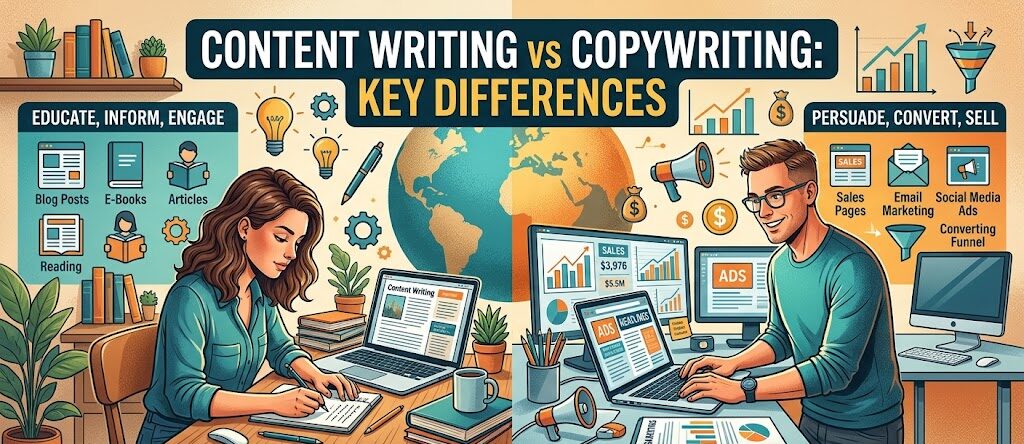
If you are new to freelancing, blogging or digital marketing, you might have come across the terms “content writing” and “copywriting” in job posts. Both involve writing, but the purpose, style, and business outcomes are different.
Content writing is primarily meant to inform, educate or entertain readers. Copywriting is the art of writing persuasive text that gets people to take action (e.g., buy a product, sign up for a service, click a link, or request a consultation).
In this guide, you’ll learn about the difference between content writing and copywriting, skills needed for each, income, career options, common mistakes, and which path suits you as a beginner.
What Is Content Writing?
Content writing is the process of creating useful written material for a specific audience. Its purpose is usually to educate, inform, entertain, answer questions, or build trust over time.
A content writer may create a blog post explaining how to start freelancing, a news article reporting an event, or an SEO guide that helps readers solve a problem. Content can support a business, but it does not always ask the reader to make an immediate purchase.
Google recommends creating original, reliable, people-first content that genuinely helps readers instead of content produced only to manipulate search rankings.
Common Types of Content Writing
| Format | Main purpose |
|---|---|
| Blog posts | Explain topics, answer questions, and attract organic traffic |
| News and SEO articles | Report facts, trends, or developments |
| E-books and guides | Teach a topic in greater depth |
| Website articles | Build topical authority and visibility |
| Newsletters | Share updates and nurture an audience |
| Case studies | Show how a product, service, or strategy solved a problem |
| Social media education posts | Inform or engage followers |
Example of Content Writing
Suppose the topic is “10 Healthy Morning Routines for Students.”
A content writer may:
Explain why morning routines are useful.
Share practical habits.
Discuss time-management tips.
Include examples for students with different schedules.
Link to related resources.
The article may mention a product or service, but its main job is to provide value.
Primary goal: Build long-term trust, attract relevant visitors, increase engagement, and help readers make informed decisions.
What Is Copywriting?
Copywriting is writing created to persuade readers to take a specific action. That action may be purchasing a product, downloading an e-book, booking a call, joining a mailing list, or clicking an advertisement.
A copywriter focuses on the reader’s problem, the product’s benefit, and the reason to act now. Indeed, “copywriting” similarly describes written material designed to sell a product or service, while “content writing” generally focuses on educating, informing, or entertaining readers. indeed
Common Types of Copywriting
| Format | Main purpose |
|---|---|
| Sales pages | Persuade visitors to purchase |
| Product descriptions | Present features as useful benefits |
| Landing pages | Generate leads or conversions |
| Search and display ads | Attract attention and encourage clicks |
| Email campaigns | Drive clicks, sales, or registrations |
| Social media ads | Generate quick interest and action |
| Video scripts | Hold attention and influence decisions |
| Calls to action | Tell the reader what to do next |
Example of Copywriting
For the same student audience, a copywriter might write:
“Start your day with more focus. Download our free 7-day student morning routine and build a schedule that actually fits your life.”
This message focuses on the reader’s desired result and includes a clear action.
Primary goal: Generate a response, such as a click, lead, sale, booking, or subscription.
Content Writing vs Copywriting
The easiest way to remember the difference is the following:
Content writing attracts and educates.
Copywriting persuades and converts.
| Element | Content writing | Copywriting |
|---|---|---|
| Main purpose | Inform, educate, or entertain | Persuade and sell |
| Typical tone | Helpful, explanatory, and conversational | Direct, emotional, and strategic |
| Usual length | Often medium- or long-form | Often short or tightly structured |
| SEO role | Frequently focused on organic visibility | Usually focused on conversion, though SEO copywriting also exists |
| Main outcome | Traffic, trust, engagement, and shares | Clicks, signups, sales, or enquiries |
| Target audience | Readers, learners, and researchers | Buyers, leads, and decision-makers |
| Examples | Blogs, guides, articles, and newsletters | Ads, sales pages, emails, and product pages |
| Success metrics | Rankings, page views, time on page, and engagement | Conversion rate, revenue, click-through rate, and leads |
However, the line is not always fixed. A blog post can include persuasive calls to action, and a sales page still needs informative content. Many experienced writers use both skills together.
A Simple Practical Example
Imagine a company selling an online SEO course.
A content writer might create:
“A Beginner’s Guide to Keyword Research”
The article teaches readers how to find and evaluate keywords. It may gently recommend the company’s course at the end.
A copywriter might create:
“Learn Keyword Research in 30 Days—Join the Beginner SEO Course”
The copy focuses on outcomes, objections, benefits, trust signals, and registration.
Both pieces are valuable, but they serve different stages of the customer journey. Content often helps people discover and understand a topic. Copy helps them decide what to do next.
Skills Required for Each
Some foundational skills overlap, but the emphasis changes.
| Skill | Content writing | Copywriting |
|---|---|---|
| Grammar and clarity | Essential | Essential |
| Research ability | Essential | Important |
| SEO knowledge | Frequently important | Useful, especially for search ads and landing pages |
| Storytelling | Useful | Useful |
| Audience research | Essential | Essential |
| Persuasive writing | Helpful | Essential |
| Consumer psychology | Helpful | Highly useful |
| Sales funnel knowledge | A basic understanding helps | Often important |
| Brand voice adaptation | Important | Essential |
| Conversion tracking | Helpful | Very useful |
Skills for Content Writers
Content writers should learn the following:
Search intent and keyword research.
Article structure and heading hierarchy.
Fact-checking and source evaluation.
Internal linking and basic on-page SEO.
Clear explanations and readable formatting.
Editorial guidelines and brand voice.
Original examples instead of generic summaries.
Skills for Copywriters
Copywriters should understand:
Customer pain points and motivations.
Benefits versus product features.
Calls to action.
Objection handling.
Offers, guarantees, and trust elements.
Email sequences and landing-page structure.
Basic conversion testing and performance metrics.
A useful copywriting exercise is to convert a feature into a benefit. For example:
Feature: “The app offers automated reminders.”
Benefit: “You can stay on schedule without checking your task list repeatedly.”
Which One Pays More?
There is no universal answer because payment depends on experience, niche, client budget, project complexity, location, and results.
In many freelance markets, copywriting can command a higher project fee because the work is directly connected to leads, sales, and revenue. However, strong content writers can also earn well through technical writing, finance, SaaS, healthcare, legal content, content strategy, and editorial work.
| Project | Content-writing focus | Copywriting focus |
|---|---|---|
| 1,000-word blog post | Research, structure, SEO, and clarity | Usually not the main format |
| Product description | Explain product use and details | Highlight benefits and drive purchases. |
| Landing page | Provide supporting information | Convert visitors into leads |
| Email sequence | Educate and nurture subscribers | Encourage clicks or sales |
| Social media post | Inform or engage followers | Capture attention and prompt action |
Treat online rate examples carefully. A price shared in a blog post is not a guaranteed market rate. Before accepting work, clarify the word count, research requirements, revisions, deadline, usage rights, and payment terms.
Which Should You Choose as a Beginner?
Choose content writing first if:
You enjoy researching and explaining topics.
You like writing blogs, guides, or articles.
You want to develop a strong foundation in SEO.
You prefer building trust over time.
You are comfortable writing longer pieces.
Choose copywriting first if:
You enjoy psychology, marketing, and persuasion.
You like writing short, powerful messages.
You are interested in advertising and sales.
You enjoy studying customer behaviour.
You want to work on landing pages, emails, or ad campaigns.
For many beginners, content writing feels easier because the structure is more educational and research-based. That does not mean it is simple. High-quality content requires original thinking, accurate research, useful examples, and a clear understanding of the audience.
A Beginner-Friendly Starting Plan
Step 1: Learn the Basic Difference
Before creating a portfolio, understand the purpose of each format. Ask yourself: “Am I helping the reader understand something, or am I asking the reader to act?”
Step 2: Select One Starting Service
Begin with one clear service, such as:
SEO blog writing.
Website content writing.
Product descriptions.
Social media captions.
Email writing.
A focused service is easier to explain to potential clients.
Step 3: Create Three to Five Samples
Your samples can be self-created. For example:
One SEO blog post.
One product description.
One landing-page section.
One promotional email.
One social media ad.
Do not copy existing brand content. Create original samples for imaginary or clearly labeled practice brands.
Step 4: Build a Simple Portfolio
You can use a website, Notion page, Google Drive folder, or WordPress portfolio. Include your service, writing samples, short introduction, contact method, and relevant experience.
Step 5: Find Suitable Opportunities
Look for work through LinkedIn, professional communities, direct outreach, job boards, and freelance platforms. Read the brief carefully before quoting a price.
Step 6: Add the Second Skill
Once you understand article structure, learn persuasive writing. If you begin with copywriting, learn SEO and long-form content to expand your opportunities.
Common Mistakes to Avoid
Treating every blog post as a sales page.
Writing promotional copy without understanding the customer.
Using keywords unnaturally.
Making income promises without evidence.
Publishing unedited AI-generated text.
Ignoring facts, sources, and author information.
Focusing only on word count instead of reader value.
Accepting unclear briefs without discussing revisions and deadlines.
Using exaggerated claims such as “guaranteed rankings” or “instant income.”
For AdSense websites, Google advises publishers to create unique, relevant content and avoid unnecessary repetition, misleading claims, and pages made only for search engines. A clean layout, useful navigation, readable typography, and properly optimized images also support a better user experience.
Key Takeaways
Content writing and copywriting are related but different skills.
Content writing mainly informs, educates, or entertains.
Copywriting mainly persuades readers to take action.
Blogs and guides are common content-writing formats.
Ads, sales pages, and promotional emails are common copywriting formats.
Content writing often supports traffic and trust.
Copywriting often supports leads, sales, and conversions.
Beginners can start with either skill based on their interests.
Learning both skills can make you more valuable to clients.
Strong writing, research, audience understanding, and editing matter in both fields.
Frequently Asked Questions
What is the main difference between content writing and copywriting?
Content writing is usually created to inform, educate, or entertain. Copywriting is created to persuade the reader to take a specific action, such as buying, subscribing, or contacting a business.
Is content writing easier than copywriting?
Content writing may feel more straightforward for beginners because it follows an educational structure. However, producing accurate, original, well-researched content is also a demanding professional skill.
Can a content writer become a copywriter?
Yes. Content writers already develop skills in research, audience understanding, grammar, and communication. They can build copywriting ability by learning persuasion, customer psychology, offers, calls to action, and conversion-focused writing.
Which skill is better for freelancing?
Neither is automatically better. Content writing may offer more opportunities for blogs and SEO articles, while copywriting can be valuable for ads, landing pages, emails, and product marketing.
Do copywriters need to know SEO?
SEO is not required for every copywriting role, but it is useful. Knowledge of search intent, keyword placement, landing page optimization, and user experience can help copywriters work on websites and search campaigns.
Can one article include both content writing and copywriting?
Yes. A blog post can educate readers and end with a relevant call to action. The educational sections use content-writing techniques, while the call to action may use copywriting techniques.
How can a beginner create writing samples without clients?
Create original practice samples for imaginary businesses or familiar industries. Clearly label them as portfolio samples, and show different formats such as a blog post, product description, email, or landing page section.
Which one pays more: content writing or copywriting?
Copywriting may pay more for some projects because it is closely linked to business conversions. Actual earnings vary by niche, experience, client budget, quality, negotiation, and measurable results.
Conclusion
The difference between content writing and copywriting comes down to the intended result. Content writing helps people learn, discover, and trust. Copywriting helps people decide and act.
If you are new to online writing, start with the skill that matches your natural interests. Practice consistently, create a small portfolio, learn audience research, and improve your SEO and persuasion skills over time. A writer who can both educate and convert can offer more complete value to clients.
Start with one sample this week—a helpful blog post or a short product page—and use it to begin building your writing career.
Pingback: Can AI Replace Human Writers in Content Creation? 5 Critical Comparison